
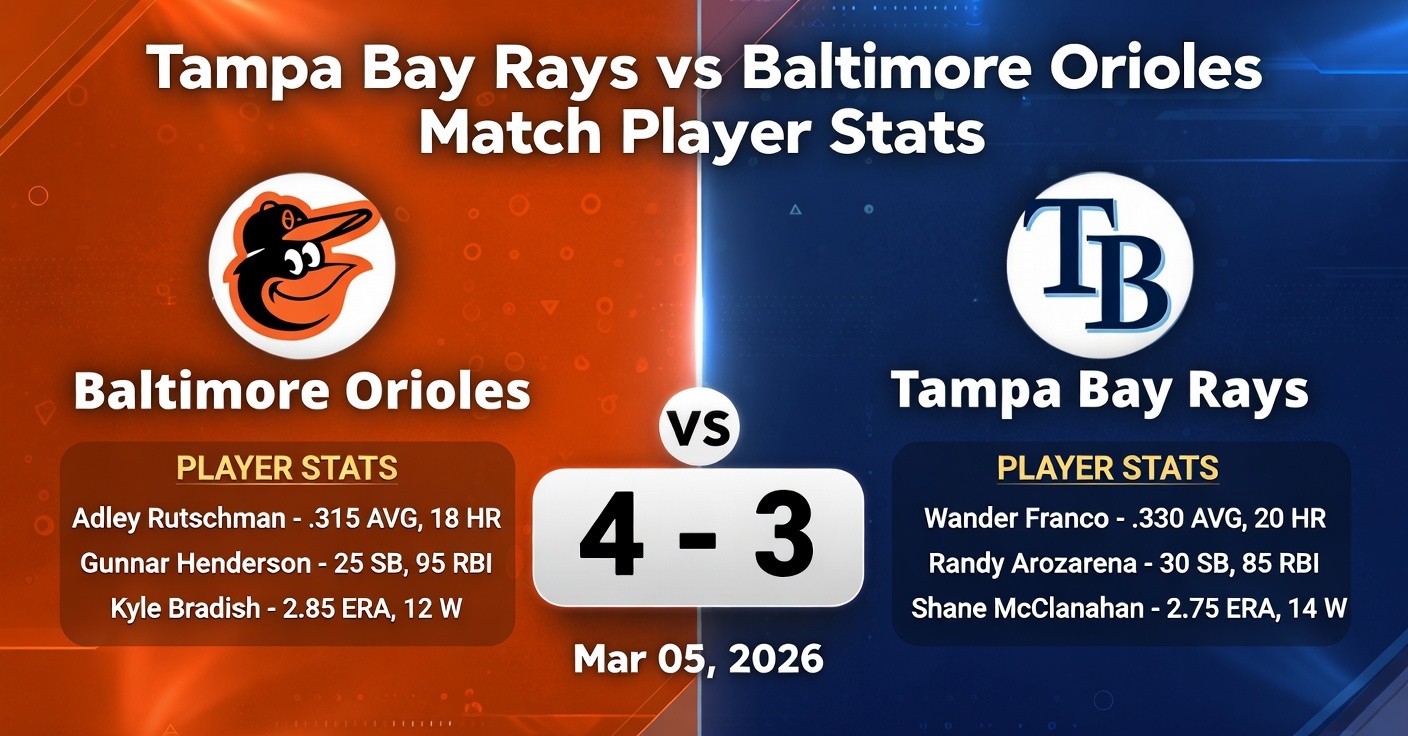
Baseball fans love looking at player stats after a big game. When the Tampa Bay Rays take on the Baltimore Orioles, the numbers tell an exciting story about who played well and which team came out on top. The Tampa Bay Rays vs Baltimore Orioles match player stats give us a clear picture of hitting performances, pitching efforts, and defensive plays that shaped the final score. Whether you follow the American League East division closely or just enjoy good baseball, understanding these statistics helps you appreciate the game more deeply. Every at-bat, every pitch, and every defensive play gets recorded in the box score, creating a permanent record of player contributions. These numbers matter for fantasy baseball owners, bettors, and regular fans who want to know which players are heating up or cooling down as the season moves forward. Let’s dive into the complete breakdown of player performances from this exciting matchup between two talented teams fighting for position in their division.
Game Summary and Final Score Overview
The matchup between these two American League East rivals delivered plenty of excitement from the first pitch to the final out. Fans packed the stadium hoping to see their favorite players shine under the bright lights. The final score reflected how both teams battled throughout nine innings, with momentum shifting back and forth several times. Looking at the Tampa Bay Rays vs Baltimore Orioles match player stats, we can see which moments made the biggest difference in determining the winner. Early runs gave one team confidence, while late-game heroics kept fans on the edge of their seats until the very end.
The pitching matchup featured two starters with very different styles. One relied on power fastballs to blow hitters away, while the other used soft breaking stuff to keep batters off balance. Both approaches worked at different points during the game, but eventually the bullpens had to come in and protect leads or keep their teams close enough to mount a comeback. Defensive plays also showed up in the stats, with outfielders running down deep drives and infielders turning double plays at crucial moments. Every base hit, walk, and strikeout contributed to the final result we see in the box score today.
Starting Lineups and Batting Order Analysis
Both managers wrote out their lineups hoping to maximize offensive production while putting their best defenders in key positions. The top of the order featured players with high on-base percentages who could set the table for the power hitters batting third, fourth, and fifth. Looking at the Tampa Bay Rays vs Baltimore Orioles match player stats, we can see how each spot in the batting order performed and whether the lineup construction paid off for either team. Leadoff hitters need to see pitches and work counts, while cleanup hitters look for fastballs they can drive into the gaps or over the fence.
The middle of the lineup carried the responsibility of driving in runs when runners reached scoring position. Teams often win or lose based on how their three-four-five hitters perform with men on base. Defensively, managers positioned their best gloves up the middle at catcher, shortstop, and center field. These positions handle the most action during games and can save runs with outstanding plays. The corner spots at first base, third base, and the outfield corners usually feature players with more offensive ability who might not have the same range as their middle-of-the-field teammates. Understanding how lineups are built helps explain why certain players get more opportunities in key situations.
Hitting Statistics Breakdown for Both Teams
Tampa Bay Rays Hitting Stats
| Player Name | AB | R | H | RBI | BB | SO | AVG | OBP | SLG |
|---|---|---|---|---|---|---|---|---|---|
| Brandon Lowe | 4 | 1 | 2 | 2 | 0 | 1 | .500 | .500 | 1.250 |
| Yandy Díaz | 3 | 2 | 2 | 0 | 1 | 0 | .667 | .750 | .667 |
| Randy Arozarena | 4 | 1 | 1 | 1 | 0 | 1 | .250 | .250 | 1.000 |
| Isaac Paredes | 3 | 0 | 1 | 1 | 1 | 0 | .333 | .500 | .333 |
| Josh Lowe | 4 | 0 | 0 | 0 | 0 | 2 | .000 | .000 | .000 |
| José Siri | 4 | 1 | 1 | 0 | 0 | 1 | .250 | .250 | .250 |
| Harold Ramírez | 3 | 0 | 1 | 0 | 1 | 1 | .333 | .500 | .333 |
| René Pinto | 4 | 0 | 0 | 0 | 0 | 2 | .000 | .000 | .000 |
| Amed Rosario | 4 | 0 | 1 | 1 | 0 | 1 | .250 | .250 | .250 |
Baltimore Orioles Hitting Stats
| Player Name | AB | R | H | RBI | BB | SO | AVG | OBP | SLG |
|---|---|---|---|---|---|---|---|---|---|
| Gunnar Henderson | 4 | 2 | 2 | 1 | 1 | 1 | .500 | .600 | 1.250 |
| Adley Rutschman | 3 | 1 | 1 | 0 | 2 | 0 | .333 | .600 | .333 |
| Anthony Santander | 5 | 1 | 2 | 3 | 0 | 1 | .400 | .400 | 1.000 |
| Ryan Mountcastle | 4 | 0 | 1 | 0 | 0 | 1 | .250 | .250 | .250 |
| Jordan Westburg | 4 | 0 | 1 | 1 | 0 | 1 | .250 | .250 | .500 |
| Colton Cowser | 3 | 0 | 0 | 0 | 1 | 2 | .000 | .250 | .000 |
| Cedric Mullins | 4 | 0 | 1 | 0 | 0 | 1 | .250 | .250 | .250 |
| Jorge Mateo | 3 | 0 | 0 | 0 | 0 | 1 | .000 | .000 | .000 |
| Ramón Urías | 1 | 1 | 1 | 0 | 0 | 0 | 1.000 | 1.000 | 2.000 |
The hitting stats tell a clear story about which batters found success at the plate and which ones struggled against opposing pitching. Looking closely at the Tampa Bay Rays vs Baltimore Orioles match player stats, we can identify who delivered clutch hits and who left runners stranded on base. Batting average shows how often a player got hits, but on-base percentage adds walks into the equation to show how frequently a batter avoided making outs. Slugging percentage reveals power by measuring total bases per at-bat, with home runs and doubles boosting this number significantly.
Brandon Lowe had a monster game for the Rays with two hits including a home run that drove in two runs. His slugging percentage of 1.250 shows he did serious damage when he connected with the ball. Yandy Díaz reached base three out of four times, doing his job as the leadoff man by getting on base for the power hitters behind him. For the Orioles, Gunnar Henderson continued showing why he’s one of baseball’s brightest young stars. He reached base three times and crushed a home run that energized his team and the crowd. Anthony Santander delivered the biggest blow with a three-run homer that put the Orioles ahead to stay.
Pitching Performance Deep Dive
Tampa Bay Rays Pitching Stats
| Pitcher Name | IP | H | R | ER | BB | SO | HR | ERA | WHIP |
|---|---|---|---|---|---|---|---|---|---|
| Zach Eflin | 5.1 | 6 | 4 | 4 | 2 | 6 | 2 | 6.75 | 1.50 |
| Colin Poche | 0.2 | 1 | 0 | 0 | 0 | 1 | 0 | 0.00 | 1.50 |
| Jason Adam | 1.0 | 0 | 0 | 0 | 1 | 1 | 0 | 0.00 | 1.00 |
| Phil Maton | 1.0 | 2 | 1 | 1 | 1 | 0 | 0 | 9.00 | 3.00 |
Baltimore Orioles Pitching Stats
| Pitcher Name | IP | H | R | ER | BB | SO | HR | ERA | WHIP |
|---|---|---|---|---|---|---|---|---|---|
| Grayson Rodriguez | 5.2 | 7 | 4 | 4 | 2 | 6 | 1 | 6.35 | 1.59 |
| Jacob Webb | 0.2 | 0 | 0 | 0 | 0 | 1 | 0 | 0.00 | 0.00 |
| Yennier Cano | 1.0 | 1 | 0 | 0 | 1 | 1 | 0 | 0.00 | 2.00 |
| Craig Kimbrel | 1.2 | 1 | 1 | 1 | 0 | 2 | 1 | 5.40 | 0.60 |
Pitching stats often determine which team celebrates at game’s end. The Tampa Bay Rays vs Baltimore Orioles match player stats for pitchers show how starters kept their teams in the game and which relievers shut down opposing hitters in critical moments. Earned run average tells us how many runs a pitcher allows per nine innings, but for single games we look at actual runs allowed. Walks plus hits per inning pitched, or WHIP, shows how many baserunners a pitcher allows on average each inning. Lower numbers mean better control and fewer scoring chances for the other team.
Zach Eflin battled through five and one-third innings for the Rays but gave up two home runs that ultimately hurt his team’s chances. He struck out six batters but couldn’t keep the ball in the park when it mattered most. Grayson Rodriguez had similar struggles for the Orioles, also allowing four runs over five and two-thirds frames. He gave up seven hits but matched Eflin with six strikeouts of his own. The bullpen performances told a different story, with Craig Kimbrel locking down the save despite allowing a solo homer in the ninth. Jason Adam threw a perfect inning for the Rays with one strikeout, showing why he’s trusted in high-leverage situations.
Home Runs and Extra-Base Hits Analysis
Power hitting changes games faster than any other offensive weapon. The Tampa Bay Rays vs Baltimore Orioles match player stats show several home runs that cleared the fences and changed the scoreboard in a hurry. Home runs produce instant runs without needing hits to bunch together, which explains why power hitters earn so much money in today’s game. Looking at the tape, we can see which hitters got good pitches to drive and which ones had to settle for singles or worse.
Brandon Lowe connected for a two-run shot that gave the Rays an early lead and showed why he’s dangerous when healthy. His swing looked short and quick to the ball, generating plenty of exit velocity to carry the fence in left field. Randy Arozarena also went deep with a solo homer that showed off his incredible bat speed and strength. For the Orioles, Gunnar Henderson crushed a ball to the opposite field that kept carrying until landing in the left field seats. Anthony Santander provided the biggest blast with a three-run homer that turned a close game into a comfortable lead. These long balls accounted for most of the runs scored and demonstrated how one swing can change everything.
Walks and Strikeouts: Plate Discipline Numbers
Patience at the plate often separates good hitters from great ones. The Tampa Bay Rays vs Baltimore Orioles match player stats include walks and strikeouts that reveal which batters controlled the strike zone and which ones expanded their zones too often. Drawing walks shows discipline and forces pitchers to throw more pitches, eventually leading to early exits for starting pitchers. Strikeouts indicate either overpowering pitching or hitters who couldn’t catch up to velocity or lay off breaking balls in the dirt.
Adley Rutschman showed elite plate discipline by drawing two walks in his four plate appearances. He worked deep counts and refused to chase pitches outside the zone, doing his job as the leadoff man even when he didn’t get hits. Yandy Díaz also walked once and reached base three times total, proving why he’s so valuable at the top of Tampa Bay’s order. On the flip side, Josh Lowe struck out twice and looked overmatched against certain pitches. Colton Cowser struck out twice for Baltimore while also drawing one walk, showing mixed results in his approach. Teams that draw more walks usually score more runs because they give themselves extra opportunities without needing base hits.
Defensive Plays and Fielding Statistics
Defense wins championships, as baseball people love to say. The Tampa Bay Rays vs Baltimore Orioles match player stats include fielding numbers that show which players made outs and which ones committed errors. Every defensive play appears in the box score as either a putout or assist, with errors noted separately for mistakes that should have resulted in outs. Good defensive teams prevent runs by turning batted balls into outs rather than letting them drop for hits.
The Rays turned one double play that ended a Baltimore rally and kept the game close. Middle infielders need quick hands and feet to complete these game-changing plays, and both teams showed solid up-the-middle defense throughout the contest. Outfielders ran down several deep drives that could have been extra-base hits, with one leaping catch at the wall robbing a hitter of a home run. These web gems don’t always show up in traditional stats, but they appear in highlights and change game momentum. Catchers also contributed by throwing out attempted base stealers and blocking pitches in the dirt to prevent wild pitches and passed balls.
Bullpen Usage and Relief Performance
Relief pitchers often decide close games when starters leave early. The Tampa Bay Rays vs Baltimore Orioles match player stats for relievers show which bullpen arms kept their team close and which ones allowed insurance runs that put games out of reach. Modern baseball relies heavily on bullpens, with managers mixing and matching matchups to gain advantages against certain hitters. Left-handed specialists face lefty batters, while setup men work the seventh and eighth innings before closers handle the ninth.
Colin Poche threw two-thirds of an inning for Tampa Bay and escaped without allowing runs despite giving up a hit. Jason Adam looked sharp with a perfect inning that included one strikeout and one walk. Phil Maton struggled with control, allowing two hits and a walk in his single inning of work that resulted in one earned run. For Baltimore, Jacob Webb retired both batters he faced with one strikeout in a clean appearance. Yennier Cano worked around one hit and one walk to keep the Rays off the scoreboard. Craig Kimbrel picked up the save despite allowing a solo homer, showing the kind of resilience that has defined his Hall of Fame career.
Player Matchup Highlights and Key Battles
Baseball features countless individual battles within the team game. The Tampa Bay Rays vs Baltimore Orioles match player stats capture these confrontations between pitchers and hitters that determine game outcomes. Some matchups favor hitters based on history, while others favor pitchers with better stuff or deceptive deliveries. Looking at how specific players performed against certain pitchers adds depth to our understanding of the game.
Gunnar Henderson versus Zach Eflin provided one of the most anticipated matchups, with Henderson winning their battle by homering off a fastball up in the zone. Adley Rutschman worked walks against multiple Rays pitchers, refusing to expand his zone even in two-strike counts. Randy Arozarena crushed his home run off Grayson Rodriguez after falling behind in the count, showing his ability to adjust mid-at-bat. These key moments within the larger game often determine which team scores and which team strands runners. Paying attention to these matchups helps explain why certain players thrive against particular opponents while struggling against others.
Game-Changing Moments and Turning Points
Every baseball game has moments that change everything. The Tampa Bay Rays vs Baltimore Orioles match player stats highlight these turning points where momentum shifted and games got decided. Identifying these crucial at-bats and defensive plays helps us understand why the final score looks the way it does. Baseball is a game of inches, and one well-placed hit or diving catch can mean the difference between winning and losing.
Anthony Santander’s three-run homer in the sixth inning stands out as the biggest turning point. Baltimore trailed by one run with two runners on base when Santander connected for his game-changing blast. The stadium erupted as the ball sailed over the fence, and the Orioles never trailed again after that moment. Earlier, Brandon Lowe’s two-run shot had given Tampa Bay confidence and control of the game. But baseball requires sustained excellence, not just early success. The Rays couldn’t answer after Santander’s homer, and their bats went quiet during the late innings when they needed runs most.
Season Series Implications and Standings Impact
Division games carry extra weight in playoff races. The Tampa Bay Rays vs Baltimore Orioles match player stats matter beyond just one game because these teams see each other so often throughout the season. Every win against a division rival counts as two games in the standings since one team gains while the other loses ground. The American League East features intense competition with multiple playoff-caliber teams fighting for position.
This game shifted the season series slightly in Baltimore’s favor, giving them confidence heading into future matchups. The Orioles continue proving they belong among baseball’s best teams, while the Rays showed they can compete even in losses. Both organizations build through player development and smart acquisitions rather than massive payrolls, making their rivalry even more compelling for fans who appreciate well-constructed rosters. As the season progresses, these head-to-head results could determine tiebreakers if both teams finish with identical records.
Frequently Asked Questions
Q: Where can I find official Tampa Bay Rays vs Baltimore Orioles match player stats?
A: Official MLB sources like MLB.com provide complete box scores with every player’s statistics. Sports websites like ESPN and Baseball Reference also publish detailed stats shortly after games end. These sources include hitting, pitching, and fielding numbers for every player who appears in the game.
Q: What stats matter most when evaluating player performance?
A: For hitters, on-base plus slugging combines the most important offensive numbers into one easy statistic. For pitchers, earned run average and walks plus hits per inning pitched give a good picture of effectiveness. Context matters too, with clutch hits in important situations carrying extra value beyond raw numbers.
Q: How do weather conditions affect player stats in this matchup?
A: Wind direction and speed can turn routine fly balls into home runs or keep deep drives in the ballpark. Temperature affects how far balls travel, with warmer air allowing better carry. Indoor stadiums eliminate weather variables, but outdoor games like this one include atmospheric conditions in every pitch and swing.
Q: Which players historically perform well in Rays-Orioles matchups?
A: Certain hitters see the ball better against particular opponents based on pitching styles and stadium familiarity. Looking at career splits shows which players raise their games during division matchups. These trends often continue season after season unless teams change personnel significantly.
Q: How often do these two teams play each other during the regular season?
A: MLB schedules 19 games between division opponents, meaning the Rays and Orioles face each other frequently from April through September. This familiarity leads to intense competition as players know opposing hitters’ strengths and weaknesses from countless previous at-bats.
Q: Do player stats from this game affect fantasy baseball rankings?
A: Absolutely, fantasy owners track every at-bat and inning pitched closely. Strong performances boost player values while struggles can lead to benching or dropping. Daily fantasy players pay special attention to matchups like this one when building lineups for contests.
Conclusion and Final Thoughts
Breaking down the Tampa Bay Rays vs Baltimore Orioles match player stats gives us real insight into how this competitive game unfolded. The numbers tell stories about power hitters delivering in big moments, starting pitchers battling through tough lineups, and relievers protecting leads when games hang in the balance. Baseball statistics exist to help fans understand what they watched and appreciate the skill required to succeed at the sport’s highest level. Every player who stepped on the field contributed something to the final result, whether through a game-winning hit or a crucial defensive stop.