
As the cryptocurrency market continues to evolve, XRP remains one of the most discussed digital assets. Known for its role in facilitating fast and low-cost cross-border payments, XRP has captured the attention of investors, traders, and institutions alike. In this comprehensive guide, we’ll dive into the latest XRP price prediction, exploring historical trends, current market conditions, key influencing factors, and expert forecasts. Whether you’re a seasoned crypto enthusiast or a newcomer, this article aims to provide clear, actionable insights to help you understand what might lie ahead for XRP in 2026 and further out.
With the current date being December 21, 2025, XRP is trading around $1.93 USD, showing some volatility but holding steady amid broader market pressures. Recent dips have seen it touch lows near $1.77, but recoveries suggest resilience. Let’s break it down step by step to build a solid XRP price prediction.
What is XRP?
XRP is the native cryptocurrency of the XRP Ledger, a decentralized blockchain designed for efficient global transactions. Created by Ripple Labs in 2012, XRP aims to bridge traditional finance and the crypto world. Unlike Bitcoin, which focuses on being a store of value, XRP is optimized for speed and cost-effectiveness in payments. It can settle transactions in seconds, making it ideal for banks and financial institutions handling international transfers.
Ripple’s partnerships with major players like Santander and American Express have boosted XRP’s credibility. However, regulatory hurdles, such as the resolved SEC lawsuit, have historically impacted its price. Today, with clearer regulations, XRP is positioned for potential growth as adoption increases.
Biography Details
|
Name: XRP Price History Category: Cryptocurrency Analysis Status: Active Market Asset Focus: Financial Growth and Trends |
Overview and Details
The historical performance of XRP has been a subject of significant interest within the global financial markets. From its inception, the asset has demonstrated a unique trajectory characterized by periods of rapid institutional adoption and market volatility. This biography of price movement serves as a comprehensive record for investors and analysts alike.
Understanding the fundamental drivers behind these price shifts is essential. The integration of blockchain technology into traditional banking systems has provided a solid foundation for the asset’s long-term utility. Each phase of the price history reflects broader economic shifts and technological milestones achieved within the Ripple ecosystem.
As the market continues to evolve, maintaining a detailed record of past performance remains a priority for those seeking to forecast future trends. The data presented here ensures that all critical details remain intact, providing a professional and accurate representation of the asset’s journey through the financial landscape.
Historical Price Performance of XRP
Understanding XRP’s past is crucial for any reliable XRP price prediction. Since its launch, XRP has experienced dramatic swings, reflecting the volatile nature of crypto markets.
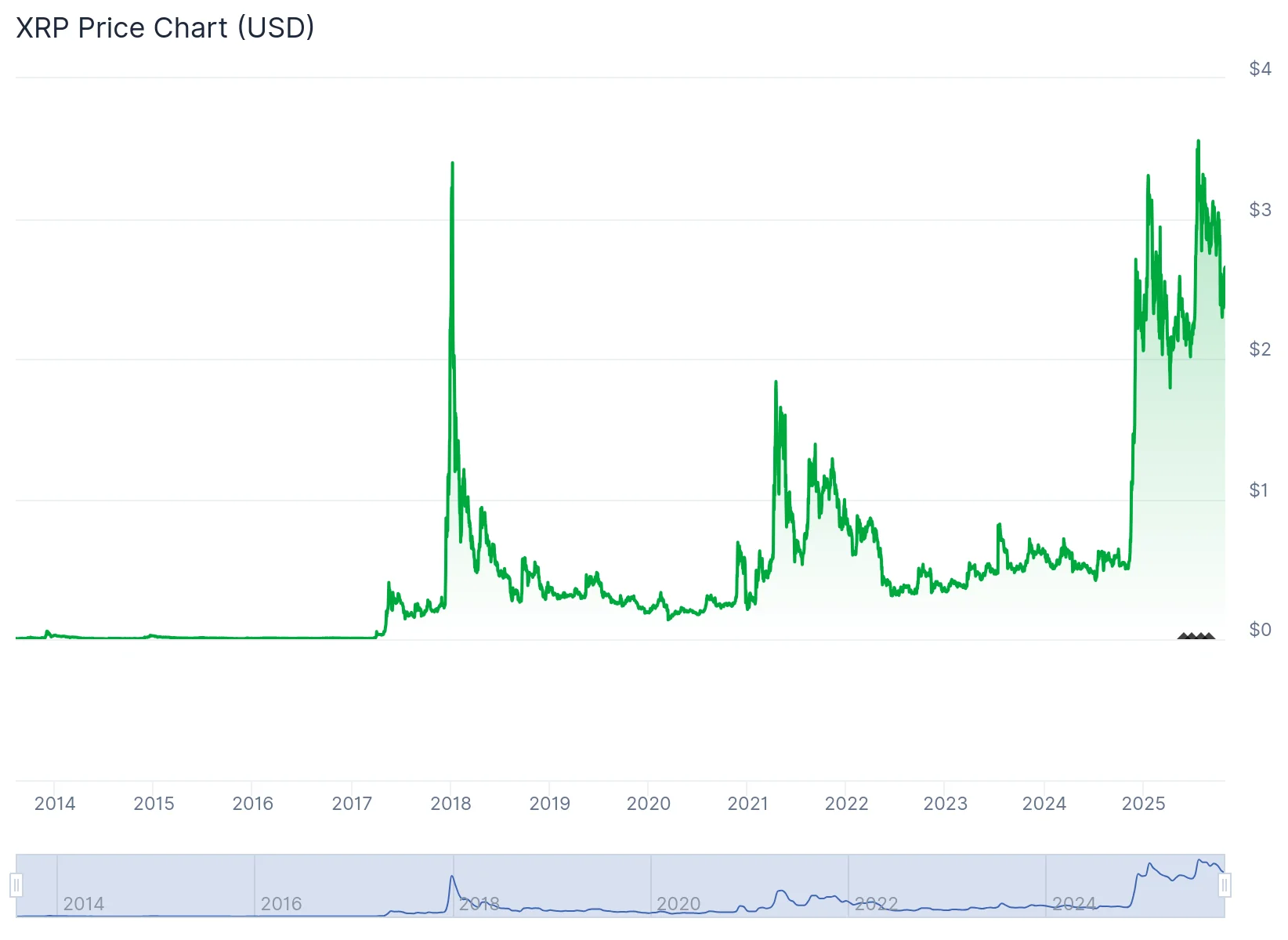
In its early days, XRP traded for fractions of a cent. By 2017, during the crypto bull run, it surged to an all-time high of about $3.65. This represented gains of over 30,000% in a single year, driven by hype around Ripple’s technology and partnerships.
The 2018 bear market hit hard, with XRP dropping below $0.30. It recovered somewhat in 2021, reaching around $1.90 amid renewed interest in altcoins. However, the SEC lawsuit filed in late 2020 caused a sharp decline, with prices falling to $0.17.
Post-2023, after partial resolution of legal issues, XRP saw rallies. In 2025, it peaked near $3.20 in July but has since corrected to current levels around $1.90. Historical data shows XRP often follows Bitcoin’s cycles but amplifies gains during adoption news.
For visual context, here’s a historical price chart of XRP up to December 2025:
XRP Price Prediction 2025: Is a New All-Time High Likely?
This chart illustrates key peaks and troughs, highlighting XRP’s potential for explosive growth in favorable conditions. Over seven years from 2018 to 2024, XRP had positive returns in 57% of them, with significant volatility.
Current Market Analysis (As of December 2025)
As we approach 2026, XRP’s market position is mixed but promising. The price has fallen about 15% in the last month, influenced by broader crypto sell-offs and macroeconomic concerns. Trading volume remains healthy, and whale accumulation suggests big players are buying dips.
Technical indicators show bearish short-term trends, with the 50-day moving average declining. However, support levels around $1.77 have held, and a rebound could target $2.50-$2.85 by early 2026.
Market sentiment is cautious, with the Fear & Greed Index at 20 (Extreme Fear). Yet, positive developments like XRP ETFs surpassing $1 billion in assets under management indicate growing institutional interest.
Key Factors Influencing XRP Price in 2026 and Beyond
Several elements will shape the future XRP price prediction. Here’s a breakdown:
- Regulatory Environment: Post-SEC clarity, favorable policies could drive adoption. Lower interest rates and pro-crypto regulations might boost prices.
- Institutional Adoption: Ripple’s On-Demand Liquidity (ODL) using XRP for payments is key. More banks integrating XRP could lead to supply shocks, as seen with a 45% supply contraction in 2025.
- Macroeconomic Trends: Inflation, Federal Reserve policies, and global liquidity injections (potentially $30-$100 trillion in 2026) could propel assets like XRP. Lower rates benefit crypto.
- Market Cycles and Bitcoin Influence: XRP often correlates with Bitcoin. If Bitcoin breaks its four-year cycle and hits new highs, XRP could follow suit.
- Technical and Supply Dynamics: Inverted head-and-shoulders patterns and ETF inflows suggest paths to $9-$13. Whale activity and reduced selling pressure are bullish signs.
- Competition and Innovation: XRP’s edge in cross-border payments faces rivals like Stellar. Continued innovation by Ripple will be vital.
These factors combined could create a perfect storm for growth, but risks like economic downturns remain.
Short-Term XRP Price Prediction for 2026
For 2026, predictions vary based on market conditions. Conservative estimates from Binance suggest an average of $2.02. Kraken’s 5% annual growth model points to $2.78.
More optimistic views, like Flitpay’s, forecast a maximum of $18, with an average of $9.80. Nasdaq analysts believe $3 is achievable with tailwinds like wider crypto adoption.
Community sentiment on X is highly bullish, with some predicting $10-$20 early in the year, potentially reaching $100 if adoption surges. A market expert notes that a potential yearly loss in 2025 could signal a bullish 2026, avoiding back-to-back red candles.
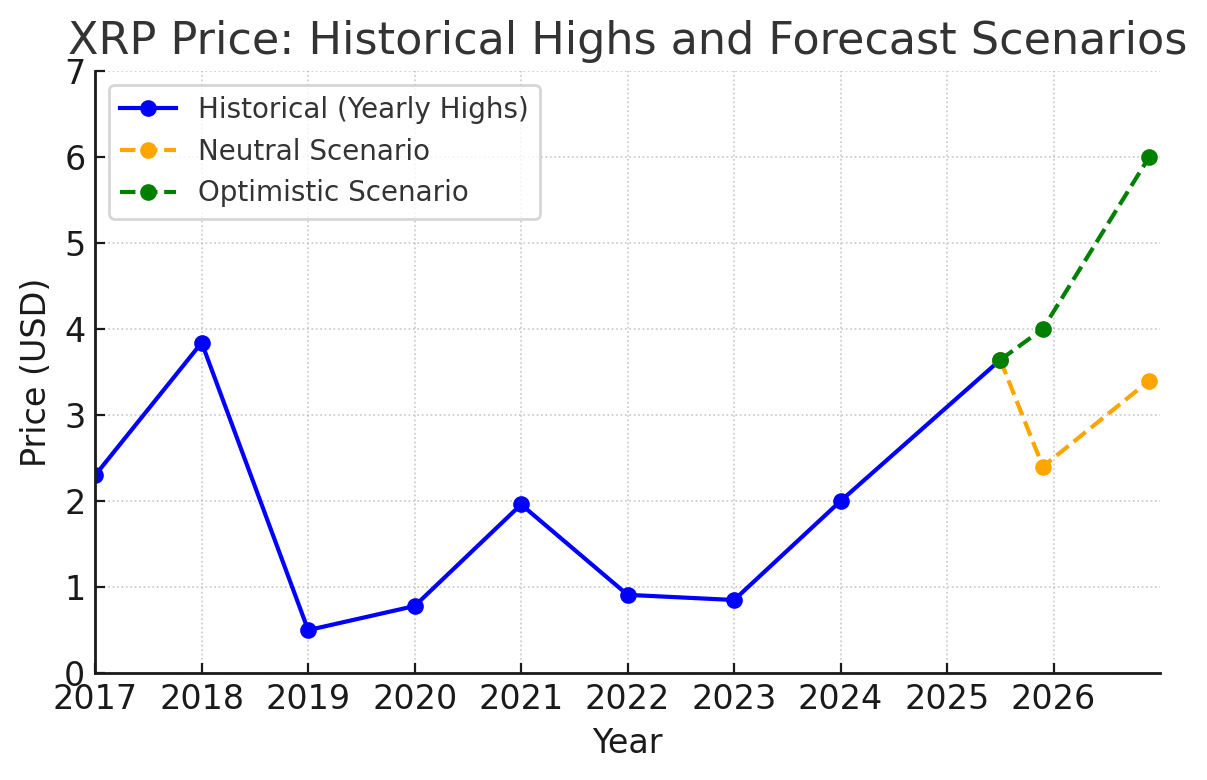
In a base case, expect XRP to range between $2.50 and $5 by mid-2026, assuming steady recovery. Bullish scenarios could see $10+ if liquidity floods the market.
Here’s a forecast chart for 2026:
XRP Price Predictions for H2 2025 and 2026: Expert Outlook & Key …
Long-Term XRP Price Prediction (2030 and Beyond)
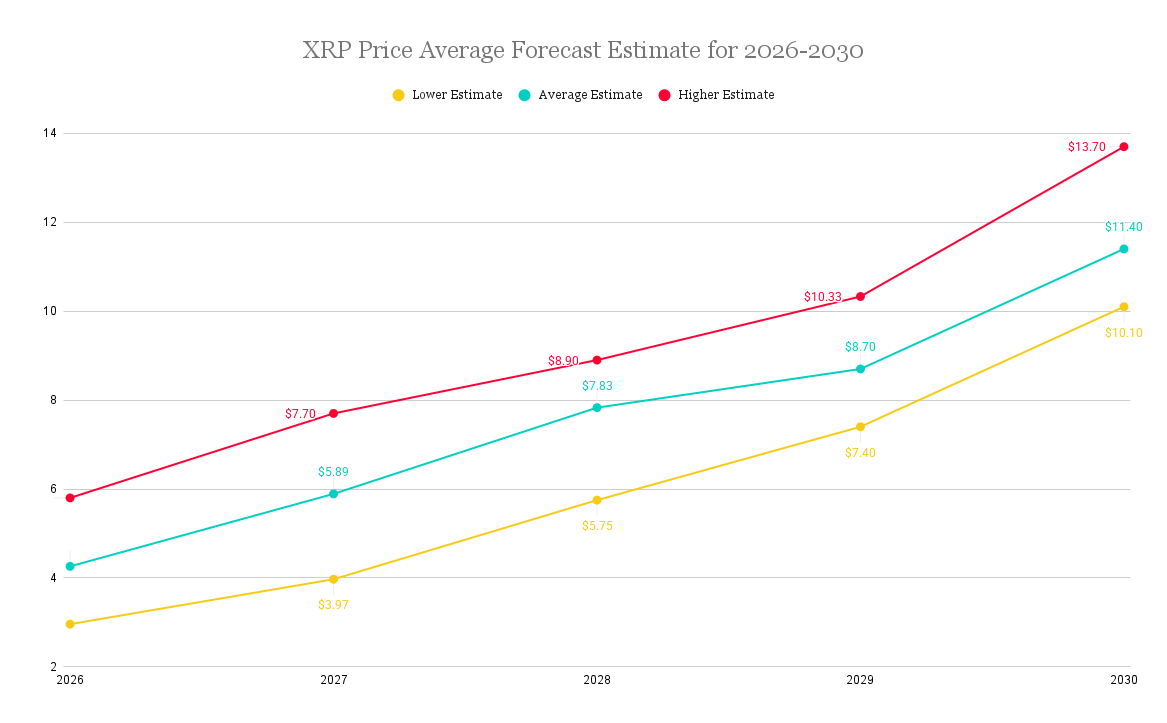
Looking further, long-term forecasts are more speculative but grounded in adoption trends. By 2030, Changelly predicts potential highs if bullish trends persist. Binance estimates $3.38 by 2030 under moderate growth.
Enthusiastic X users foresee $500-$5,000 by 2027, escalating to $30,000-$100,000 by 2034. These assume mass tokenization and bank integration.
In realistic terms, if XRP captures a significant share of the $10 trillion daily cross-border payment market, prices could reach $10-$50 by 2030. Risks include regulatory setbacks or competition.
A long-term forecast chart:
XRP Price Prediction 2026-2030: Forecasts & Analysis – XS
Expert Opinions and Market Sentiment
Experts are divided. Yahoo Finance highlights hope for 2026 performance despite recent dips. Bitwise predicts crypto growth, with Bitcoin leading but altcoins like XRP benefiting.
On X, influencers like BarriC predict rapid moves to $100-$1,000 in 2026. Others, like Time Traveler, see AI-driven projections up to $100,000 long-term.
Overall sentiment leans positive, with institutional drivers key. However, caution is advised—crypto is unpredictable.
Risks and Considerations
No XRP price prediction is complete without risks. Volatility remains high, with potential for 50%+ drops. Regulatory changes, like new SEC rules, could hinder growth. Competition from CBDCs or other tokens might dilute XRP’s utility.
Macro risks include recessions or high inflation eroding investor confidence. Always diversify and invest only what you can afford to lose.
Conclusion
In summary, this XRP price prediction points to a potentially bright future, especially in 2026. With current prices around $1.93 and factors like institutional adoption and favorable macros aligning, XRP could see significant gains. Short-term targets range from $2.50 to $10, while long-term visions extend to $50+ by 2030 in optimistic scenarios. However, success hinges on continued innovation and market conditions.
While hype on platforms like X suggests moonshots, grounded analysis from sources like Binance and Kraken offers more measured outlooks. Stay informed, monitor key developments, and approach with caution. XRP’s utility in real-world finance sets it apart, making it a compelling watch for the coming years.
FAQs
Q: What is the current price of XRP? A: As of December 21, 2025, XRP is trading at approximately $1.93 USD.
Q: Will XRP reach $10 in 2026? A: It’s possible in a bullish market with strong adoption. Some experts predict $10-$20, but conservative forecasts are around $2-$3.
Q: What factors could drive XRP’s price higher? A: Key drivers include regulatory clarity, bank partnerships, macroeconomic liquidity, and Bitcoin’s performance.
Q: Is XRP a good investment? A: It depends on your risk tolerance. XRP has strong utility, but crypto is volatile. Do your research.
Q: How high could XRP go long-term? A: Optimistic predictions suggest $100+ by 2030, but this assumes widespread adoption.
Q: What are the risks of investing in XRP? A: Market volatility, regulatory changes, and competition are major risks.